

A Tuber's Journey to Coasts Unknown
Editors' Desk
Some of the earliest humans to leave Africa are thought to have followed the coastline east, along the Arabian Peninsula and across to the shores of South Asia, the southern coast of India among the first landfalls anywhere outside the continent our species began on. Long before cassava had even been domesticated in a Brazil nobody outside it yet knew existed, that stretch of Indian coastline and the West African coast 6,000 km away were already connected, by foot and by boat, by the oldest journey any of us ever made. What happened to a plant called cassava this last half millennium is a newer chapter of a much older story.
Kappa arrived in Kerala the way many good things arrive by sea, a little by surprise. Native to Brazil, it came with Portuguese sailors in the seventeenth century, and the tuber is said to have taken its Malayalam name from the very kappals, ships, that carried it. It sat at the edge of the local diet for two centuries, a curiosity in a botanist’s garden, until Travancore’s Visakham Thirunal Rama Varma, ruling a kingdom repeatedly emptied by famine, had it planted deliberately as insurance against the next failed harvest. His subjects, distrustful of the strange root, uprooted it in secret at night to test what the king had forbidden them to touch, and found in it exactly what he had hoped they would. It was a plant that asked little of the soil and gave generously in return. Kerala starved again during the Second World War, when rice imports from Burma stopped, but by then kappa had rooted itself deep enough in the ground and in memory to carry the state through. It has fed celebrations rather than only survived hunger ever since.
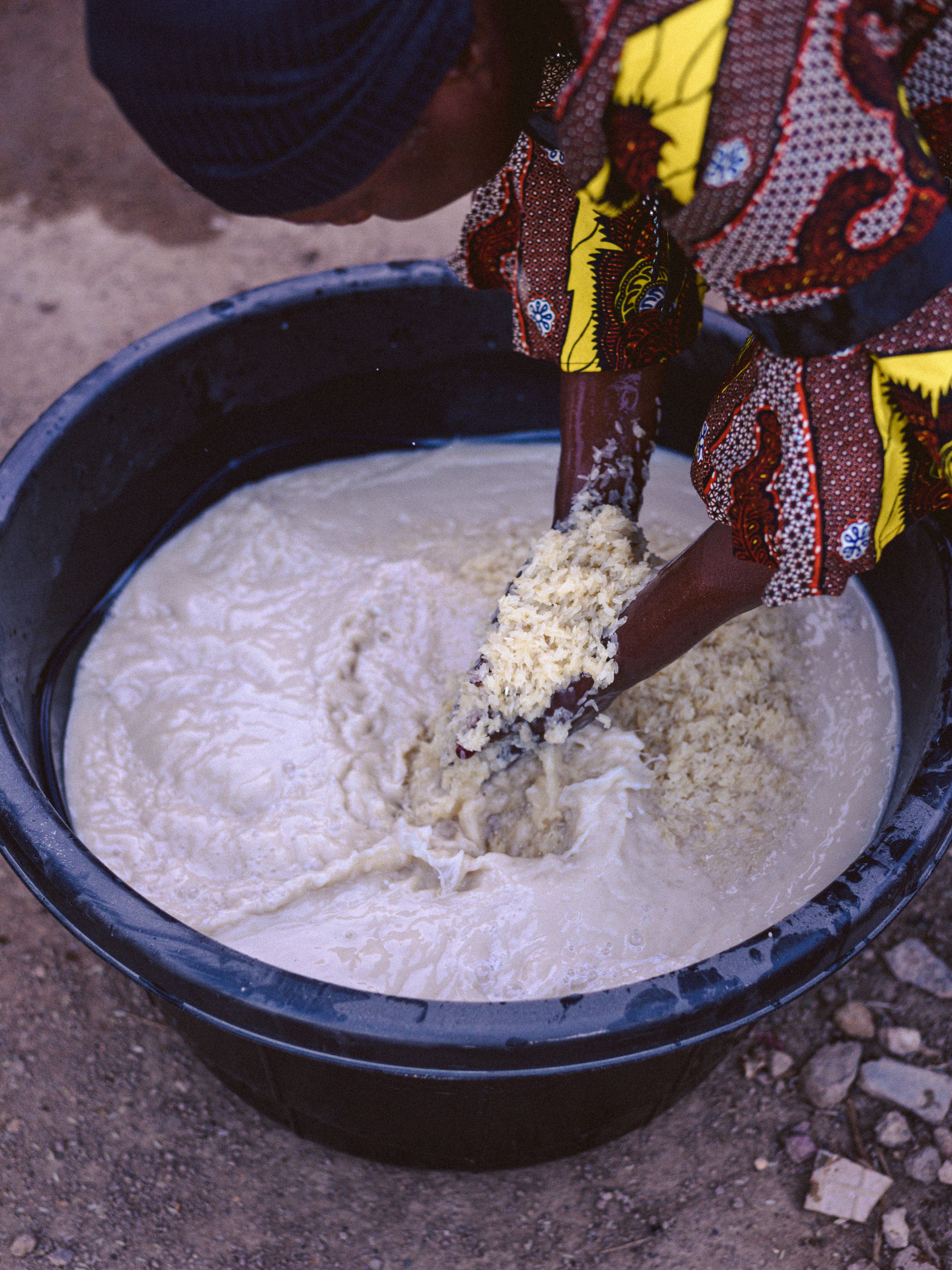
Cassava’s route to West Africa ran through the same Portuguese trading ships, arriving on that coast around the same centuries it arrived on Kerala’s, the plant fanning out from Brazil in more than one direction at once. West African hands, already skilled in pounding yam into fufu, found in the new root, cassava, and the dish simply grew a second life. When migration, forced and later chosen, carried West African communities across the Atlantic, the pounding motion travelled with them into Caribbean kitchens where cassava was already growing, cultivated there for centuries before by the Taino tribe, and fufu found yet another home. Puerto Rico calls it mofongo. Cuba calls it fufú de plátano. The Dominican Republic calls it mangú. Ghana still calls it fufu.
What kappa and fufu share is a family resemblance with two communities on two different coastlines, connected first by that oldest of migrations long before either dish existed, and then again by the same tuber, treated with patience and a little salt. Kappa now appears at Kerala weddings mashed into a biriyani that breaks every rule of what a biriyani is supposed to be, and relished as much as its rice sibling. It sits on the menus of Kochi’s most expensive restaurants beside the meen curry much like it does in Kerala homes. Fufu, in Ghanaian, Nigerian and Caribbean households alike, is the dish set at the centre of the table when there is company to feed and something worth marking, also eaten by hand, in a manner that turns a meal into an act of trust between the people at it.

Cities which have built homes for migrants far away from their own shorelines have a way of putting these two histories back within walking distance of each other in a global melting pot. Los Angeles and New York both hold Malayali kitchens serving kappa and curry a few streets from West African and Caribbean kitchens serving fufu and soup, each community there on its own timeline, but open to the world. What forms in that proximity is closer to a sister cuisine than a coincidence of two diasporas who had never met on their original coasts, discovering, plate by plate, a kinship of cassava. Long separated by distance and by the accident of history that kept them from ever comparing notes directly, they turn out to have been cooking from the same instinct all along. The shape of the motion is identical in both places, a thumb pressing a well into mashed starch, taught by grandmothers on coastlines that had been quietly linked since long before either of them was born. Cassava did not know, leaving Brazil in the hold of a Portuguese ship, that it was retracing a route humanity had already walked once, on foot, along a coast, tens of thousands of years earlier. Kerala and West Africa, one plant and one very old shoreline apart, found their way back to the same gesture eventually.
Notes from return.: This piece draws on food history reporting from Whetstone Magazine and Grokipedia on kappa’s introduction to Travancore by Visakham Thirunal Rama Varma, GOYA’s coverage of cassava’s dual role as famine crop and feast dish in Kerala, and Wikipedia, Britannica, Remitly and the Plant Humanities Lab on fufu’s origins in Ghana and its adaptation across the Caribbean. The coastal dispersal route connecting early human migration out of Africa to South Asia’s southern coast reflects a widely supported model in population genetics and archaeology, sometimes called the southern coastal route, though exact paths and dates remain the subject of ongoing research.
