

The Architect's Design Language
Luxe Desk
In 1973, Hilton International opened a property in Nairobi. It was seventeen storeys, slab-sided and air-conditioned, and it offered the same rooms, the same lobby proportions and very nearly the same menu as Hilton properties in London and Caracas and Hong Kong. Conrad Hilton had spent the previous two decades building what he called America’s ambassadors abroad, hotels whose consistency was the product, each one a proof that a travelling American businessman would find the same reliable standard of comfort regardless of which city he had been sent to. The idea worked commercially and spread. By the time the chain model was fully established across the industry in the 1980s, the major hospitality groups had developed a design language so standardised that an interior firm could specify a complete hotel room package in a studio in Atlanta and ship it to Accra, with no one in Atlanta having looked very carefully at Accra. The Hilton senior vice president of global design said in 2024 that the goal of new properties was spaces that felt like members clubs. The Marriott brief to its long-standing interior firm, Hirsch Bedner Associates, calls for signature looks creating a symbiosis between luxury and sensitivity. Both statements are honest descriptions of what the major chains have built with no mention of the city the building is in.
A guest arriving in Nairobi or Jakarta or Cairo after a long flight is seeking rest first, and rest, for many travellers who can afford this class of hotel, means the temporary suspension of the unfamiliar. It offers a controlled environment where the difficulty of being somewhere foreign is held at a comfortable distance with all the excitement, but little of the local experience. The chain hotel delivers this efficiently. What it also delivers, without advertising the fact, is a particular relationship to the city outside its windows, one in which the city becomes scenery rather than context, something to be viewed from the correct elevation and sampled in managed doses rather than encountered without filters. The Orientalist gaze operating as a hospitality product with the world arranged for the convenience of someone passing through it who has paid for the right to find it legible and non-threatening. It is not a contemptible preference. Travel is an escape before it is an education, and the person who flies twelve hours and wants a rainfall showerhead and a familiar pillow has not done anything wrong. The problem is when this preference becomes the only brief that the hospitality industry knows how to answer, because it produces hotels that extract from a place - its skyline, its weather, its proximity to monuments and markets, while returning nothing to it - not its materials, not its craft traditions, not its accumulated knowledge about how to be comfortable in this specific climate. The luxury that genuine architecture offers is different in kind: the sense of privilege that comes from being given access to what the place knows, on terms that remain comfortable enough that the knowing is a pleasure rather than an ordeal.
When Geoffrey Bawa took the commission for the Kandalama Hotel in Sri Lanka in 1992, the developer wanted to build next to Sigiriya, the 5th-century royal complex built around and atop a massive rock formation, which would have placed a hotel in the immediate surroundings of one of the country’s most significant historic sites. Bawa insisted on moving the building eleven kilometres away, to a site above a reservoir called the Kandalama Tank, where the Sigiriya rock becomes visible as a shape on the horizon across the water rather than as a backdrop to a carpark. The building runs for a kilometre along a jungle-clad cliff face, its corridors winding so that views open at the end of them. It rests on columns, so that rainwater and spring water flow freely from the mountainside into the lake underneath it. Three trees were felled during the entire construction. The foliage specified for the roofline was chosen to grow down over time and eventually camouflage the building from the opposite shore. Bawa refused to allow any signage, including exit signs, wanting guests to ask the staff when they needed to find something, because the asking would produce a conversation, and the conversation would carry the story of the place. What the developer wanted was a hotel. What Bawa built was a living space specific to the 11 sq. km. of a very particular reservoir, a cliff, a horizon, a particular grove of trees.

The flat roofs at Kandalama work because the hotel sits in Sri Lanka’s central dry zone, where pitched roofs built for coastal monsoon rainfall would have been wrong. This kind of reasoning with the building’s form arrived at through understanding what the climate actually does rather than through a specification document produced in Atlanta, is what distinguishes architecture that knows where it is from the kind that does not. Hassan Fathy understood the same thing about Egypt. Working in the 1940s and 1950s with mud brick and traditional Nubian construction techniques, he built houses in New Gourna outside Luxor that used wind-catch towers, mashrabiya screens and the thermal mass of thick earthen walls to cool interiors without any mechanical system, because those were the tools the climate required and the local building tradition had already solved. The Egyptian government demolished most of New Gourna eventually, but Fathy’s documentation of the principles published in Architecture for the Poor in 1973, the same year the Nairobi Hilton opened, remains one of the most precise accounts of what it costs to ignore what a place already knows about keeping its inhabitants comfortable.
Adrian Zecha opened Amanpuri in Phuket in 1988 and charged $250 a night when the best alternative nearby was $75. Ed Tuttle designed forty pavilions for a private beach using a controlled palette of local materials and a geometry that resolved the Thai vernacular into something precisely proportioned without stripping it of what it understood about shade, ventilation and the relationship between interior and exterior in tropical heat. Peter Muller’s Amandari in Bali followed in 1989, built within a working rice terrace, the suites following the contours of the land, the design brief requiring the building to earn its position in the landscape rather than impose on it. The category these properties created of the top-tier resort organised around the proposition that a building could be deeply of its place and deeply comfortable, had not previously existed in the hospitality industry because the industry’s formative decades had been spent arguing that comfort required standardisation. Zecha’s position was that standardisation was precisely what comfort did not require, and that the guest who paid $250 in 1988 was paying for the experience of being somewhere specific, irreplaceable and entirely unlike the room they had left in Tokyo or London or New York.
The greige that covers most surfaces in the mid-to-upper-tier chain hotel of 2025 is the end state of the opposing argument. It belongs to no cultural tradition and therefore offends none, photographs cleanly under the ambient lighting conditions that hotel rooms always present, and reads as neutral luxury in markets where the booking decision is made on a screen. The art is large, abstract, and chosen to mean nothing to anyone. The same rainfall showerhead, the same USB port in the same bedside unit, the same blackout curtains on the same track appear in Jakarta and Nairobi and Lisbon because they were specified from the same document produced by a firm whose brief requires consistency across six hundred properties rather than response to any single place. The Hirsch Bedner Associates brief for a Marriott property does not ask what the city knows, instead focusing solely on what the brand requires, never questioning that perhaps the brand does not know what it needs.
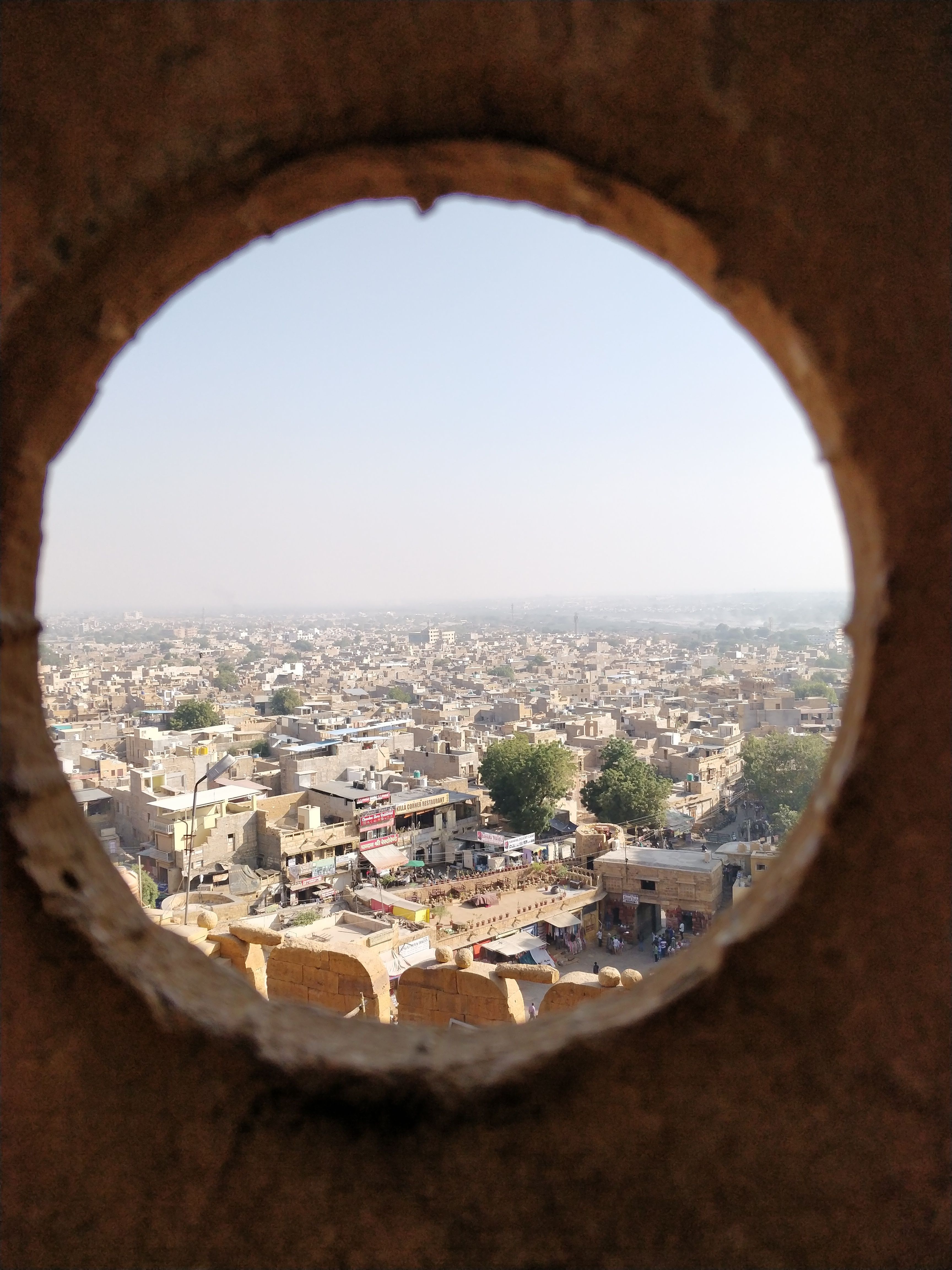
The Leela’s forthcoming Jaisalmer property works with tented villas spread across dunes, oriented for the light of the Thar Desert, the materials local and the silhouette low, a building trying to understand the desert before occupying it. Foster and Partners designed the Ritz-Carlton at Amaala on the Red Sea as a low structure modelled on the vernacular of the nearby port of Al Wajh, the sand dunes preserved as natural shade barriers, the building oriented toward the water because that is where the wind comes from. The Four Seasons in Cartagena’s Getsemaní neighbourhood restores historic buildings into a single property rather than erasing them for a new construction, which means the building carries the neighbourhood’s own history as part of its fabric rather than as a theme applied to a neutral shell. These are large-budget projects and they are asking questions the chain hotel brief does not contain: what does this place say, and how does the hotel resident listen albeit to a whisper of it?
Bawa reportedly said that what matters are ideas, that if ideas can stand up in the climate, in the seas of green, in the silhouettes of mountains and the scorching sunshine, then an architecture exists. The Kandalama Hotel is now thirty years old and the foliage has been growing down from the roofline all that time. From the opposite shore of the reservoir, in certain light, the building is almost invisible.
Travel writing has always been the literary form of power. This traveller arrives somewhere, not discovers it.
